From a letter of the Rebbe
I am in receipt of your letter in which you write about various recent events in your life - which were not in the category of obvious good - and you ask what your reaction should be.
In general, as you surely know, Jews are guided by the Torah, the "Torah of Life," which is to say that Torah is the Jew's true guide in everyday life. The Torah is also called Torah Or, the "Torah of Illumination," since it illuminates the Jew's life and its instructions are as clear and lucid as light itself.
One of the best-known portions of the Torah, which Jews recite daily in both morning and evening, is the portion of the Shema [prayer], in which the Torah tells us to love G d "with all your heart and with all your soul and with all your might."
The Hebrew word m'odecha, generally translated as "your might," also conveys the meaning of middah - "measure" or "dimension," as our Sages explain. This means that a Jew has to love G-d regardless of the kind of "deal" he thinks is meted out to him by Divine providence.
This profound love is to express itself, as the text indicates, in the study of Torah and the observance of its mitzvos (commandments), particularly the mitzvos of tefillin and mezuzah which are mentioned specifically, and particularly so since tefillin is symbolic of all the mitzvos.
Moreover, inasmuch as the hand tefillin is placed on the left arm facing the heart, the seat of the emotions, and [the head tefillin] on the head facing the brain, the seat of the intellect, tefillin symbolizes that a Jew is to be totally involved - both emotionally and intellectually - in serving and fulfilling His commandments.
In other words, whatever happens in a Jew's life must not in any way affect his love of and devotion to G-d, nor his everyday life and conduct in accordance with the Torah and mitzvos. (Needless to say, the mitzvah of reciting the Shema daily is not reserved for exceptional Jews, but is for each and every Jew.)
The question now arises: Is the above something that can really be implemented, and if so, how is one to explain how this can actually be implemented?
To be sure, the human intellect is limited and cannot possibly fathom the Divine wisdom that is in the Torah. On the other hand, the Torah itself describes the Jewish people as a "wise and understanding people," and it provides at least some explanation that helps us to understand, in however limited a degree, G-d's ways.
One of the basic teachings of the Torah is that G-d does not expect anything of a human being that is beyond the human capacity to carry out.
This, in fact, is eminently understandable: Even a human being, who is a very long way away from absolute perfection, would not expect a tool that he has fashioned to perform in a capacity greater than its original design. Certainly G-d, the Creator of man, knows man's capacities.
From this it naturally follows that when a Jew faces any kind of a test of faith, it is certain that he has been given the capacity to overcome it. And the more difficult the test, the greater are the individual's capacities.
The reason that an individual is tested is not that G-d wants to know how well he will conduct himself, but in order that this person be afforded the opportunity to realize his potential, even that which is unknown to him. And when one's potential capacities are released and activated, they become part and parcel of his or her arsenal, to be used for personal as well as communal benefit. ...
From Healthy in Body, Mind and Soul, compiled by Rabbi Sholom B. Wineberg, published by Sichos in English


The Soul

G-d's Candle is Man's Soul
About Me

- Rabbi Rapp
- Melbourne, Victoria, Australia
- My aim to help students develop into proud and effective Jews empowering them to lead an optimistic, meaningful life and actualising their full potential. It is during these years at university that a strong and accessible organisation such as ours is so important. We are here to assist you.
Monash Clayton - Wednesdays 1.00 pm to 2.00pm
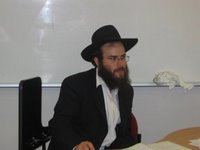
"Rabbi Yoseph Nerenberg gives a shiur
Monash Caulfield Lunchtime lectures
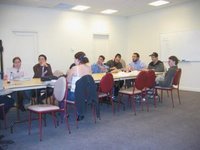
Merkos presents "Rabbi Yoseph Nerenberg"
No comments:
Post a Comment