When it came time to construct the Sanctuary's vessels, discussed in this week's portion, Tetzaveh, Moses was unsure of how to make the gold menora. G-d instructed him to throw the gold into the fire, and the menora miraculously took shape by itself.
Many of the Sanctuary's vessels were far more complicated to construct than the menora, but Moses had no difficulty with them. What then did Moses find so troublesome about the menora, especially since G-d had already shown him what it looked like on Mount Sinai?
What Moses found difficult to understand was not the Menora’s form but its function. How could a physical object - any object - serve as a "dwelling place" for G-d and become holy? What do a table, an ark, a menora or an altar have to do with the Divine Presence?
Indeed, King Solomon posed the same question in the verse, "The highest heavens cannot contain You; how then can this House?"
Logic seems to dictate that a "dwelling place" for G-d be constructed of spiritual building blocks: learning Torah, praying with the right intention, loving and fearing G-d, etc. But how can physical objects bring sanctity into our lives?
It was this concept that Moses found troubling, which found expression most particularly in the Menora. The purpose of the Menora was to serve as "testimony to all mankind that the Divine Presence rests in Israel."
By means of the Menora, the light of holiness was to disperse throughout the world; Moses wondered how any physical object could perform such a tremendous function.
G-d's answer was that, in truth, this task is indeed beyond human ability. Only an infinite and unlimited Creator can grant a gold Menora the power to light up the entire world with holiness; the only reason it does is because such is G-d's will.
This was alluded to when the Menora took shape in the fire without human intervention. Similarly, the entire concept of the Sanctuary serving as a dwelling place for G-d is Divine in origin and not human.
This provides us with an eternal lesson for today, for despite the fact that the physical Temple has not yet been restored (may it be rebuilt by Moshiach immediately), every Jew possesses a "Sanctuary to G-d" in his heart. Furthermore, the Jew's primary function in the world is to imbue all he comes in contact with holiness.
The Torah tells us that it's not enough to bring sanctity into life's spiritual dimensions; even the most mundane aspects of our lives must serve as a "Sanctuary" for G-d's Presence. This can be achieved miraculously if we throw ourselves into the "fire" of love for our fellow Jew - just like the menora that took shape in a supernatural manner.
Adapted from Likutei Sichot of the Rebbe, Vol. 1


The Soul

G-d's Candle is Man's Soul
About Me

- Rabbi Rapp
- Melbourne, Victoria, Australia
- My aim to help students develop into proud and effective Jews empowering them to lead an optimistic, meaningful life and actualising their full potential. It is during these years at university that a strong and accessible organisation such as ours is so important. We are here to assist you.
Monash Clayton - Wednesdays 1.00 pm to 2.00pm
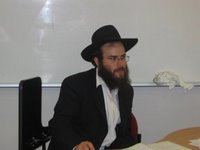
"Rabbi Yoseph Nerenberg gives a shiur
Monash Caulfield Lunchtime lectures
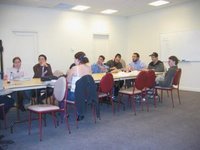
Merkos presents "Rabbi Yoseph Nerenberg"
No comments:
Post a Comment