For the miracles, for the redemption... for the wonders You have wrought for our ancestors, in those days, in this time. In the days of Matityahu... the Hashmonean and his sons, when the wicked Hellenic regime rose up against Your people Israel to make them forget Your Torah and violate the decrees of Your will...
from the Chanukah prayers
The story is told of a group of coachmen in a small town in the backwoods of Russia who heard some disturbing news from the big city. Frightening things were happening in the world: bands of iron were being laid across the plains and forests of Russia, upon which an iron monster, who ate coal and spewed fire and smoke, would move three times faster than the fleetest team of horses. It was said that this demon could pull 100 iron coaches and thousands of passengers. No longer would anyone need to hire a coach and coachman to go from town to town. No longer will merchants negotiate the price of a wagon to take their wares to the market in Leipzig. People were already traveling from Moscow to Petersburg in this manner, and soon these roads of iron will connect every town and townlet in Russia.
“And how many horses does this machine use?” asked Misha, the oldest and ablest of the coachmen. “None whatsoever,” said Grisha, who was the source of the news. “That's the whole point: no horses, and no coachmen.” “Impossible,” said Misha with authority. “A hundred iron coaches, no horses, impossible!”
“But here's the letter from my cousin from Smolensk. He writes: ‘The iron rails have already reached the city, and next month the first of these machines will arrive from Moscow.’ After much debate, the coachmen decided to travel to the city and see for themselves.
At the appointed time, they stood at the edge of the crowd that had gathered on the platform at the newly erected station. They heard it before they saw it, an unearthly sound of crashing metal and a thousand charging bulls. And then, in a huge cloud of black smoke, it appeared: a line of iron coaches, stretching as far as the eye could see, traveling faster than the mightiest horse, a shrieking iron monster at their head. It pulled up alongside the cheering crowd, let go a final ear-piercing wail, and died.
As the crowd surged towards the train the coachmen remained rooted to the ground, mouths agape, stunned to the very core of their souls. Misha was the first to recover. Ignoring the train of carriages and their disembarking passengers, he boldly approached the engine. Carefully he circled the still shuttering monster, running his eyes over every inch of its surface. He peered into the engineer's cabin and crouched between the wheels to examine the undercarriage. Muttering to himself, he rejoined his fellow coachmen on the platform.
“Amazing!” he kept saying to himself. “What a horse! What a horse!”“A horse?!” asked his colleagues.“Of course,” said the veteran coachman. “There's got to be a horse hidden somewhere in there. Think of it---a horse, probably no bigger than a kitten, who can pull one hundred iron coaches. What a horse!”Why did the Maccabees revolt? It was not political independence they sought, nor was taxation--with or without representation--the issue. Matityahu and his sons took up arms because the Syrian-Greeks, who ruled the Holy Land, wished to “make them forget Your Torah and violate the decrees of Your will.”
It was not the Torah per se that Hellenic regime wished to uproot from the people of Israel, but Your Torah. Nor was the Greek against the Jews' practice of the Torah's precepts, the mitzvos, as a moral and ethical code; it was specifically the decrees of Your will that he wished to outlaw.
The Decrees
The Torah's 613 mitzvos fall into three general categories: laws (mishpatim), testimonials (eidot) and decrees (chukim).
“Laws” are the most “rational” of the mitzvos. Indeed, we can envision the human mind deducing that the rich should give to the poor, that a child should respect his parents, that murder, theft, and slander ought to be forbidden---also if these were not Divinely legislated laws.
“Testimonials” are the mitzvos which signify and commemorate. Shabbos attests to G-d's creation of the world and establishes our lives as the ongoing commitment to develop it as “partners in creation”; the Passover observances evoke the experience of freedom and the contemplation of its significance; teffilin reiterate the sovereignty of mind over heart and deed and the “binding” of all three to serve a higher end. While the mind may not necessarily have conceived these precise forms of attesting and experiencing, it certainly accepts them as “rational”. We understand the need for concrete symbols for the truths and ideals we care for, and recognize the manner in which these mitzvos instill them in our hearts and lives.
Then there are the “decrees”. These are the wholly supra-rational mitzvos, such as the prohibition against mixing meat and milk or the laws of niddah. It of these mitzvos that G-d says: “I have instituted a statute, decreed a decree: you have no license to reason it.”[1] Here the mind must acknowledge its limitations, conceding that there are truths which lie beyond its finite scope.
Humanly Divined
To the Greek, the human being was supreme. The body of the athlete, the mind of the philosopher---if perfect, man was god. To have suggested that there might be anything more transcendent than man's crowning glory, the intellect, was heresy.
Torah? By all means. The Hellenist respected the Jews' philosophy as part of the great human quest for knowledge. He also recognized the philosophical, psychological and social value of their “lifestyle.” Laws? The backbone of any civilized society. Testimonials? Also important. Decrees? Interesting---let's examine them. There has to be some reason why such a highly intelligent people are doing these things. No reason? You mean no known reason. You say no reason whatsoever? Listen, I don't understand everything---not yet, anyway. Maybe I'll never understand everything. Maybe there is no man alive today who can understand everything. Maybe no man who has ever lived who could understand everything. But everything true has a rational reason.
Listen, let's get together. We certainly have a lot to learn from each other. We'll visit your Temple, you'll visit our stadiums. We'll open a comparative religions department in Jerusalem's new Hellenist University. You know, if we apply some Aristotelian methodology to your Biblical myths, there might be some interesting results. Maybe we'll even crack some of those enigmatic “decrees”...
In Those Days, In This Time
On Chanukah, the historical Hellenist threat was overcome by a handful of Jews who insisted the Torah's decrees are “the decrees of Your will” and Your will only. They further believed that all of Torah is Your Torah: that also the most rudimentary “law” is intrinsically supra-rational, its “rational” husk external to its Divine essence.
The Chanukah lights remind us that there is the Hellenist within that must also be vanquished, a Hellenist coachman who insists that nothing exists beyond his narrow perception of reality. Torah? By all means. Laws and ceremonies? Beautiful. Decrees? Hard to accept but, hey, nobody's perfect. I'll take it on faith that there's a good reason for it. Beyond reason? Be real! There's got to be a horse in there, somewhere...
Compromise
The miracle of Chanukah was completely unnecessary.
Every Jewish schoolchild knows the story: The Greeks had defiled the Holy Temple's store of olive oil. So when the Maccabees liberated the Temple, they could not find ritually pure oil with which to kindle the menorah. Then, a single cruse of uncontaminated oil was found, enough to keep the menorah alight for a single day. Miraculously, the oil burned for eight days, until new oil could be prepared. To this day, we commemorate the miracle by kindling the Chanukah lights on each of the festival's eight days.
Strictly speaking, none of this was necessary. The law which forbids the use of ritually impure oil in the Temple would not have applied under the circumstances which then prevailed. According to Torah law, “The prohibition of impurity, if affecting the entire community, is waived”---if the entire community, or all the kohanim, or the all Temple's vessels, are ritually impure, it is permissible to enter the Temple and conduct the Temple services under conditions of impurity.[2] Nevertheless, G-d wished to show His love for His people: He suspended the laws of nature in order to enable them to rededicate the Temple without any compromise on its standards of purity---even if it be a perfectly legal and permissible compromise.
Going Overboard
Every Chanukah, we reciprocate in kind. How many lights must be kindled on the Chanukah menorah? One on the first night, two on the second, etc. Wrong. According to the Talmud, this is he law:
The mitzvah of Chanukah is [fulfilled with] a single light for each household. Those who do more than is obligatory, kindle a single light for each individual. Those who do more than those who do more than is obligatory... kindle one light on the first day and add an additional light on each succeeding day.[3]
There are Jews who buy the cheapest teffilin on the market, who give the absolute minimum that the laws of charity mandate, who employ every halachic exemption and loophole they can lay their hands on. But when was the last time you saw a single light in the window of a Jewish home on the sixth night of Chanukah? On Chanukah, we all “do more than those who do more than is obligatory” - after all, G-d did the same for us.
Fanatical Educator
The word “Chanukah” comes from the word chinuch, which means “initiation.” Chanukah celebrates the renewal of the service in the Holy Temple after it was liberated from the Greek defiler, purified, and rededicated as the seat of G-d's manifest presence in our world.
Chanukah thus serves as a model for all initiations, including the most significant initiation of all---education, a child's initiation into life (indeed, chinuch is also the Hebrew word for “education”). The uncompromising insistence on purity and perfection which Chanukah represents imparts an important lesson regarding the essence of the educator/initiator's task.
Compromise is anathema to education. To a mature tree, a gash here or a torn limb there is of little or no consequence. But the smallest scratch in the seed, the slightest nick in the sapling, results in an irrevocable deformity, a flaw which the decades to come will deepen rather than erase.
Virtually every life is faced with demands for compromise---some tolerable, others not. The educator who wishes to impart a set of values and priorities that will weather them all, must deliver, in word and example, a message of impeccable purity, free of even the slightest and most “acceptable” equivocation.
Based on an address by the Rebbe, Chanukah 5714 (1953).
[1] Midrash Rabba, Bamidbar 19:1[2] Talmud, Pesachim 79a; Mishneh Torah, Laws of Entering the Temple, 4:12.[3] Talmud, Shabbos 21a.


The Soul

G-d's Candle is Man's Soul
About Me

- Rabbi Rapp
- Melbourne, Victoria, Australia
- My aim to help students develop into proud and effective Jews empowering them to lead an optimistic, meaningful life and actualising their full potential. It is during these years at university that a strong and accessible organisation such as ours is so important. We are here to assist you.
Monash Clayton - Wednesdays 1.00 pm to 2.00pm
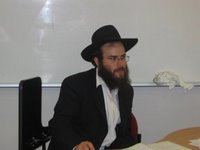
"Rabbi Yoseph Nerenberg gives a shiur
Monash Caulfield Lunchtime lectures
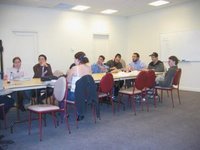
Merkos presents "Rabbi Yoseph Nerenberg"
No comments:
Post a Comment