If you search through the Jewish teachings you will find many examples of the power of a mitzva (commandment). "One mitzva leads to another," declares the Mishna in Avot. "Israel will be redeemed through tzedaka (charity)" is another such saying.Judaism also teaches about the mitzvot of non-Jews - their responsibility to transform and civilize the world, by fulfilling the seven Laws of Noah. (Don't worship idols, don't blaspheme, don't murder, don't steal, don't be sexually immoral, set up a system of justice, and, by extension, take care of the world.)
Indeed, the Lubavitcher Rebbe often emphasized the importance of every act of goodness and kindness, declaring that the imminent Redemption will be hastened through such actions. "Moshiach is ready to come now. Our part is only to increase in acts of goodness and kindness," the Rebbe responded when asked by a CNN reporter what is his message to the world.
One may ask, though, how hard do we have to work to perform an act of loving-kindness - to visit the sick - more, to make sure those who can't afford to pay a doctor or hospital nevertheless receive the health care they need, to give tzedeka to the poor - more, to follow the Talmud's dictum and be concerned for the dignity of indigent and oppressed, to say a kind word - more, to do whatever may be classified as increasing the goodness in the world?
In other words, do acts of goodness go against the grain? Do we have to train ourselves to be kind? Or, should we just follow our instincts and let the "kindness gene" take over?
Recent experiments by neuroscientists confirm the saying that "while the recipient benefits from tzedeka or from an act of kindness, even more does the giver benefit."
One experiment, conducted at the National Institutes of Health, involved asking volunteers to think about having a large sum of money, and keeping it for themselves. Another set of volunteers were asked to think about having a large sum of money, but donating it to a charity. During the experiment the neuroscientists scanned the brains of both sets of volunteers. Those thinking about helping others showed increase activity in the neural pathway for positive emotions involving the limbic system - the system that generates the sense of pleasure, associated with the production of the neurotransmitter dopamine.
Other experiments confirm the result. It goes against our nature to be cruel. Our neuron pathways reinforce the "goodness impulse."
The Chasidic masters teach us that a mitzva, an act of kindness, affects not only the individuals involved, but reaches to the Heavenly Spheres. We can understand why: human beings are a template of creation. We mirror the structure of the spiritual realms, and our actions reverberate there.
In short, when we do good, we feel good. Or, in other words, we become good when we do good, and we're hardwired to do good.


The Soul

G-d's Candle is Man's Soul
About Me

- Rabbi Rapp
- Melbourne, Victoria, Australia
- My aim to help students develop into proud and effective Jews empowering them to lead an optimistic, meaningful life and actualising their full potential. It is during these years at university that a strong and accessible organisation such as ours is so important. We are here to assist you.
Monash Clayton - Wednesdays 1.00 pm to 2.00pm

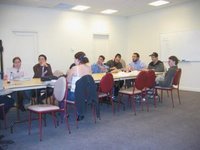
"Rabbi Yoseph Nerenberg gives a shiur
Monash Caulfield Lunchtime lectures
Merkos presents "Rabbi Yoseph Nerenberg"
No comments:
Post a Comment