by Hana Levi Julian
When Sara Elise and Rebecca Paul were planning their Bat Mitzvah in Yardley, Pennsylvania last year, they and their parents spent weeks trying to figure out what kind of ceremony would be meaningful and yet different from the usual run-of-the-mill "big bash."
The Pauls opted for an innovative program created by Chabad-Lubavitch of the Dead Sea called the "Masada Experience."
The idea is to breathe a little life into a female event that brings a young girl into womanhood. Often a girl's passage into Jewish adulthood moves quietly, with the modesty that is associated with traditional Jewish womanhood.
This, says Chabad emissary Rabbi Shimon Elharar, does not have to mean the event is not vital, exuberant and memorable. A man of his word, Elharar himself appears inexhaustible, striding up the dusty path from the entrance to the site straight to the chamber with nary a misstep. The man simply never stops moving.
"We begin the Bat Mitzvah ceremony with reading of the Shema and reciting of the chapters of psalms and selected prayers and sacred texts," explains Elharar. "This is followed by a speech delivered by the Bat Mitzvah, who is then in turn blessed by her father, who pronounces the traditional blessing upon his daughters."
This first part of the celebration concludes with an award ceremony in which the Bat Mitzvah girls receive special certificates, which include a special blessing for them and their family. Rabbi Elharar then describes the history and importance of Masada, past and present.
Following the ceremony in the ancient synagogue, the family moves to a nearby stone room which, in centuries past, served as living quarters for the Jews who rebelled against Rome.
Dressed in "Biblical" costume, a Jewish woman patiently awaits the female members of the Bat Mitzvah girls' family and group of friends. An enormous bowl of swelling challah (Sabbath bread) dough sits on a table with the other items needed to prepare the festive loaves seen at every Jewish celebration.
This is where the ceremony truly separates the men and the boys. The male members of the group are waved off to the side as they enter the chamber; welcomed, yes, but clearly participants only in the sense of being the audience as the young women-to-be take center stage next to the enormous challah bowl.
Sara Elise and Rebecca's father, his face wreathed in smiles, moves to the corner of the chamber, his video camera at the ready to record the occasion. The rabbi also stands back.
All eyes are on Sara Elise and Rebecca, their mother, grandmother and the friends who came along for the life-changing event.
"Here on Masada," gently intones the Biblical re-enacter, "women baked bread for their families just as you are about to do now. Two thousand years ago, they kneaded the dough in exactly the same way, every day .... "
She goes on to explain the commandment involved in separating out the small piece of dough that symbolically represents the portion that was once set aside for the priestly class. But, she adds, it is essential to continue to observe this commandment so that "when the Third Temple is rebuilt, we will not have forgotten, and will know what to do" once again.
Smiling, after assisting each Bat Mitzvah through her first performance of the commandment, to the applause of her family, the baker informs them, "now together we will make new Sabbath loaves in this room and thus we will repair and renew the links in the chain that were broken here at Masada two thousand years ago."
Each woman and girl gets enough dough to make a small challah, which is carefully placed on the baking sheet. Within minutes, Masada's heat has inspired the yeast to expand the loaves enough for them to be placed in the waiting oven.
The seminal rite of passage in which a Jewish girl legally enters womanhood, says Rabbi Elharar, reminds the parents of their place in the House of Israel in which "they are united with all others as one under Heaven, participating in the acceptance of Torah Commandments and their place among the Jewish People." This especially happens, he adds, "in a place which also bequeaths to one a history replete with personal sacrifice, such as occurred at Masada."
From a Jewish legal perspective, there is no particular action required for a girl to take in order to declare her entry into womanhood, as there is for a boy, who dons tefillin (phylacteries) and goes up to the Torah as part of a minyan (quorum) for the first time.
But it is equally important today, says Elharar, for a girl to understand that her passage into adulthood carries with it equal significance, and with that, responsibility under Jewish law as well.
Although Judaism does not provide for any specific ceremony to mark that passage, he adds, "There is no reason not to create a way for a girl to celebrate that event. It is so pivotal; every girl should be able to point to that time in her life, and say, 'Yes - this is how I celebrated my becoming a Jewish woman.'"
For the Pauls, the fragrant loaves that emerged from the small after they were shaped by Sara Elise and Rebecca and the women of their family and her friends were not nearly as important as the journey they took to get to them.
But as they munched on the warm challahs and drank the ice cold water provided by Rabbi Elharar in the sweltering Judean heat of Masada, Sara Elise and Rebecca's father reflected on the compulsion he had felt to bring his daughters to Masada for their Bat Mitzvah. He had been dragged back by his roots back to his Jewish homeland, he observed, "as surely as the Zealots were tied to the land and willing to die, rather than leave."
Reprinted from IsraelNationalNews.com. IsraelNationalNews - Arutz Sheva, provides 24-hr. coverage of Israel Events


The Soul

G-d's Candle is Man's Soul
About Me

- Rabbi Rapp
- Melbourne, Victoria, Australia
- My aim to help students develop into proud and effective Jews empowering them to lead an optimistic, meaningful life and actualising their full potential. It is during these years at university that a strong and accessible organisation such as ours is so important. We are here to assist you.
Monash Clayton - Wednesdays 1.00 pm to 2.00pm
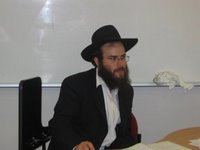
"Rabbi Yoseph Nerenberg gives a shiur
Monash Caulfield Lunchtime lectures
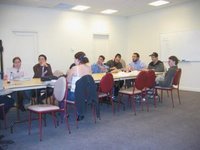
Merkos presents "Rabbi Yoseph Nerenberg"
No comments:
Post a Comment