This week's Torah portion is Korach. According to the simple reading of the portion, we see Korach as a wicked person, one who not only fought with Moses but also encouraged others to quarrel with him, as well. How, then, is it possible that we call something as holy as a Torah portion the name of a wicked person?
Chasidic philosophy offers a beautiful explanation of who Korach truly was and what we can learn from him. The name Korach is appropriate for the portion because, according to a deeper level of Torah Korach represents the striving of the Jew to reach the highest spiritual peaks.
Thus, the lesson we learn from Korach is not only a negative one, the rejection of his approach of strife, but also a positive concept, the importance of seeking spiritual peaks.
The appreciation of Korach's positive qualities, however, has to be coupled with the awareness of his negative qualities. This can be connected with a concept of general significance.
G-d desires that a Jew serve Him on his own initiative, with his own power. For this reason, the soul descends into this material world where there is a possibility to err. The intent, however, is that a Jew should make a positive choice. These qualities are reflected in the narrative of Korach.
Korach was a clever person who sought to reach the level of High Priest.
Since he had to achieve this level in this world, he had two choices how to express this holy drive. In practice, he did not choose the proper approach. However, the lesson, to use one's potentials as prescribed by the Torah, remains.
The portion of Korach teaches us a practical and applicable lesson; to quote the Previous Rebbe, "Just as a person must know his faults so that he can correct them, he must be aware of his positive qualities so that he can use them in the fullest degree possible." A Jew must realize that he is not controlled by exile and can strive to reach the highest spiritual potentials, his "holy of holies." Similarly, one has to appreciate the advantage of our generation, the last generation of exile and the first generation of redemption.


The Soul

G-d's Candle is Man's Soul
About Me

- Rabbi Rapp
- Melbourne, Victoria, Australia
- My aim to help students develop into proud and effective Jews empowering them to lead an optimistic, meaningful life and actualising their full potential. It is during these years at university that a strong and accessible organisation such as ours is so important. We are here to assist you.
Monash Clayton - Wednesdays 1.00 pm to 2.00pm
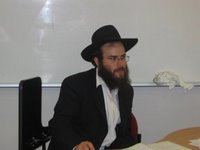
"Rabbi Yoseph Nerenberg gives a shiur
Monash Caulfield Lunchtime lectures
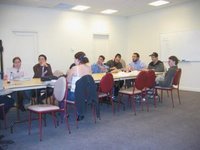
Merkos presents "Rabbi Yoseph Nerenberg"
No comments:
Post a Comment