Next week, millions of Jews throughout the world will be sitting with family and guests around brightly lit, festive tables, eating matza and bitter herbs, drinking four cups of wine and reminding each other about the miracles G-d did for the Jews.
They will be celebrating the holiday of Passover for the 3,319th time in history.
Every year since the exodus from Egypt, millions of Jews have never missed a year of Passover Seder.
One of the most basic commandments of the Passover Seder is to tell the story of going out of Egypt. In addition to this being an integral part of the Seder night, remembering that G-d took us out of Egypt is obligatory not only on Passover, but on every day of the year. It is a foundation of all Judaism, being the first of the Ten Commandments.
The Sages compiled the Hagada in order to facilitate this vital commandment. Throughout the text of the Hagada, G-d is mentioned continuously for the incredible miracles that He did for the Jews. In fact, G-d did everything; he was the "star" of the Exodus.
Strangely, however, the main protagonist of the Exodus, Moses, is mentioned only once in the entire Hagada!
Had it not been for Moses, the Jewish people would have never left Egypt at all. And even after they left, were it not for Moses, they would have returned to Egypt.
While it was G-d, Who had wrought all of the miracles of the plagues, the splitting of the sea, the manna and more, it was Moses who kept the Jewish people inspired. In fact, when the Jews thought that Moses had left them at Mount Sinai, they worshiped the Golden Calf, despite G-d's Omniscience and omnipresence.
So why isn't Moses given more credit in the Hagada? Because it Moses'
job to do only one thing; to interpret the miracles that G-d wrought in a way that brought the Jews to serve G-d on their own.
It was not Moses' job to do everything, but only one thing: to connect the Jews to G-d.
That is why, when Moses' name is mentioned in the Hagada it is in the verse, "They believed in G-d and in Moses His servant."
In other words, the Torah equates the belief in Moses with the belief in G-d, because there cannot be one without the other.
The Zohar (1:253a) equates Moses with Moshiach, because Moshiach - the final redeemer of the Jewish people, will complete the task begun by Moses - the first redeemer of the Jewish people.
In fact, Moshiach will bring the entire world to serve the Creator (through His Torah) with all their talents, skills and abilities.
At that time will be fulfilled, "And they (the entire world) will believe in G-d and Moses His servant."
And, the world will be filled with peace, prosperity and brotherhood.
Adapted from an article by Rabbi Tuvia Bolton


The Soul

G-d's Candle is Man's Soul
About Me

- Rabbi Rapp
- Melbourne, Victoria, Australia
- My aim to help students develop into proud and effective Jews empowering them to lead an optimistic, meaningful life and actualising their full potential. It is during these years at university that a strong and accessible organisation such as ours is so important. We are here to assist you.
Monash Clayton - Wednesdays 1.00 pm to 2.00pm
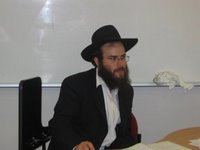
"Rabbi Yoseph Nerenberg gives a shiur
Monash Caulfield Lunchtime lectures

Merkos presents "Rabbi Yoseph Nerenberg"
No comments:
Post a Comment