This week's Torah portion, Vayeishev, recounts the birth of Peretz and Zerach, the twin sons of Judah and Tamar. The Torah relates that when Zerach "put out his hand first," the midwife tied a red thread around it as a sign, saying, "This one came out first." But Zerach drew back his hand; Peretz "broke forth" and was the first to be born.
The Torah's stories are not merely historical accounts of our progenitors. Rather, by virtue of their inclusion, they allude to events occurring later in Jewish history and reveal teachings pertinent to us in every day and age.
Our Sages teach that, by right, Zerach should have been the firstborn of the two brothers. His birthright was forfeited, however, because of a grave sin one of his descendants would commit generations later, during the time of Joshua. The sin was so great, affecting all Jews, that the twins' birth order was switched, and Peretz was born first.
The twins' names hint to an even deeper significance. The name "Zerach"
comes from the Hebrew for "shining forth," like the light of the sun which illuminates the entire world. "Peretz," literally "breaking forth," was the progenitor of King David, from whom Moshiach will descend. On a more profound level, "Zerach" and "Peretz" stand for the two types of service of G-d - the service of tzadikim (righteous), and the service of baalei teshuva (penitents).
Each type of service has an advantage not present in the other. The tzadik's worship of G-d - "Zerach" - is steady and dependable. Each day, the tzadik methodically ascends the spiritual ladder, attaining higher levels of holiness. The service of "Zerach," however, is that of those whose yearning toward G-d occurs only after an initial distancing. At such times, the baal teshuva's thirst for holiness is even greater than the tzadik's, and his service is even more impassioned. The service of the baal teshuva contains the power to "break forth" and overcome the harshest of limitations.
G-d desires every Jew to serve Him in righteousness; accordingly, Zerach's hand was extended first. But because the world was created in such a way as to accommodate sin, it was necessary for Peretz to be born first, indicating the value of returning to G-d after one has distanced himself.
Furthermore, the Final Redemption is dependent on the service of the baal teshuva, which is why Moshiach is a descendent of Peretz. The long Exile served to expiate the sins which led to the destruction of the Holy Temple, thus placing the Jews in the category of baalei teshuva.
Indeed, Maimonides states that when the Jewish nation sincerely returns to G-d, "immediately they will be redeemed."
Adapted from Talks of the Lubavitcher Rebbe, Vol. 30.


The Soul

G-d's Candle is Man's Soul
About Me

- Rabbi Rapp
- Melbourne, Victoria, Australia
- My aim to help students develop into proud and effective Jews empowering them to lead an optimistic, meaningful life and actualising their full potential. It is during these years at university that a strong and accessible organisation such as ours is so important. We are here to assist you.
Monash Clayton - Wednesdays 1.00 pm to 2.00pm
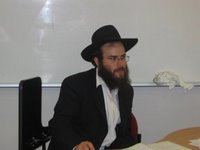
"Rabbi Yoseph Nerenberg gives a shiur
Monash Caulfield Lunchtime lectures

Merkos presents "Rabbi Yoseph Nerenberg"
No comments:
Post a Comment