The Torah tells us that when Jacob moved his family to Egypt, where the Jewish people were to reside for more than two centuries, “he sent Judah ahead... to show the way.”[1] The Hebrew word lehorot (“to show the way”) literally means “to teach” and “to instruct,” prompting the Midrash to say that the purpose of Judah’s mission was “to establish a house of learning from which would be disseminated the teachings of Torah.”[2]
But Joseph was already in Egypt, and Jacob had already received word that Joseph’s twenty-two years away from home had not diminished his knowledge of and commitment to Torah.[3] And Joseph certainly had the authority and the means to establish the most magnificent yeshivah in the empire. Why did Jacob desire that Judah—a penniless emigrant who barely knows the language—be the one to establish the house of learning that was to serve the Jewish people in Egypt?
Judah and Joseph
The children of Jacob were divided into two factions: on one side were ten of the twelve brothers, led by Judah; on the other, Joseph, whose differences with his brothers were the cause of much pain and strife in Jacob’s family.
The conflict between Joseph and his brothers ran deeper than a multicolored coat or a favorite son’s share of his father’s affections. It was a conflict between two world-views, between two approaches to life as a Jew in a pagan world.
Abraham, Isaac and Jacob were shepherds, as were Joseph’s brothers.[4] They chose this vocation because they found the life of the shepherd—a life of seclusion, communion with nature, and distance from the tumult and vanities of society—most conducive to their spiritual pursuits. Tending their sheep in the valleys and on the hills of Canaan, they could turn their backs on the mundane affairs of man, contemplate the majesty of the Creator, and serve Him with a clear mind and tranquil heart.[5]
Joseph was the exception. He was a man of the world, a “fortuitous achiever”[6] in business and politics. Sold into slavery, he was soon chief manager of his master’s affairs. Thrown into jail, he was soon a high-ranking member of the prison administration. He went on to become viceroy of Egypt, second only to Pharaoh in the most powerful nation on earth.
Yet none of this touched him. Slave, prisoner, ruler of millions, controller of an empire’s wealth—it made no difference: the same Joseph who had studied Torah at the feet of his father traversed the palaces and government halls of Egypt. His spiritual and moral self derived from within and was totally unaffected by his society, environment, or the occupation that claimed his involvement twenty-four hours a day.
The conflict between Joseph and his brothers was the conflict between a spiritual tradition and a new worldliness; between a community of shepherds and an entrepreneur. The brothers could not accept that a person can lead a worldly existence without becoming worldly; that a person can remain one with G-d while immersed in the affairs of the most depraved society on earth.
In this conflict, Joseph was to emerge the victor. The spiritual seclusion that characterized the first three generations of Jewish history was destined to end; Jacob and his family moved to Egypt, where the “smelting pit” of exile was to forge their descendants into the nation of Israel. As Joseph had foreseen in his dreams, his brother and his father bowed to him, prostrating their approach to his. Jacob had understood the significance of these dreams all along, and had awaited their fulfillment;[7] Joseph’s brothers, who found it more difficult to accept that the era of the shepherd was drawing to a close, fought him for twenty-two bitter years, until they, too, came to accept that the historical challenge of Israel was to be the challenge of living a spiritual life in a material environment.
Founding Fathers
Nevertheless, it was Judah, not Joseph, who was chosen by Jacob to establish the house of learning that was to serve as the source of Torah knowledge for the Israelites in Egypt.
The first three generations of Jewish life were not a “false start”: they were the foundation of all that was to follow. It was this foundation from which Joseph drew the strength to persevere in his faith and righteousness in an alien environment; it was this foundation upon which the entire edifice of Jewish history was to be constructed.
The Jew lives in a material world, but his roots are planted in the soil of unadulterated spirituality. In his daily life he must be a Joseph, but his education must be provided by a Judah.
Based on an address by the Rebbe, Tevet 2, 5722 (December 9, 1961)[8]
Joseph’s Calf
"If a dead body shall be found ... fallen in the field, and it not be known who has slain him ... And the city that is closest to the body, the elders of that city shall take a calf that has never been put to work, that has never drawn in the yoke. And the elders of that city shall take the calf down to a rough ravine, which shall not be worked nor sown; and they shall decapitate the calf there in the ravine... And they shall proclaim: “Our hands have not spilled this blood; our eyes have not seen. O G-d, absolve Your nation Israel, whom You have redeemed ... may the blood be forgiven them...”
Deuteronomy 21:1-8
Our sages tell us that the law of eglah arufah (“the decapitated calf”) was the last law that Jacob and Joseph studied together[9] before Joseph went off to check up on his brothers and was lost to his father for twenty-two years.
When Joseph’s brothers returned from Egypt and told their father that Joseph was alive and is the ruler of Egypt, Jacob’s “heart rejected [the news], for he could not believe them.”[10] It was only when “they spoke to him the words that Joseph spoke to them” and showed him “the agalot that Joseph had sent,” that “the spirit of Jacob was revived” and he hurried to Egypt to see his beloved son.[11] What were “the words that Joseph spoke to them”? And what were the agalot he sent? The word agalot literally means “wagons.” But the wagons to carry Jacob and his family to Egypt were sent by Pharaoh,[12] not by Joseph; and why would the sight of some wagons revive the spirit of Jacob? The agalot, explain our sages, were an allusion to the eglah arufah: Joseph was reminding his father of the last Torah law they had studied together. Yes—said Jacob upon seeing the agalot—the viceroy of Egypt is my long-lost son, and he has not forgotten the Torah he has learned in his father’s home.[13]
Out In The Field
We all acknowledge our responsibility for things that are in our control, for whatever occurs within our “jurisdiction.” But what about those things that are outside of our domain? Things over which we have no authority and only a limited influence?
This is the lesson of eglah arufah. The elders of the city nearest the murder must clarify that “our hands have not spilled this blood.” “Would it occur to anyone,” asks the Talmud, “that the elders of the beit-din are spillers of blood? But [the elders have to affirm that]... ‘We have not sent him off without provisions ... we have not sent him off without accompaniment.’”[14] The city elders are obviously responsible for everything that transpires within their jurisdiction. But the murder occurred “out in the field,” outside the domain of all the surrounding cities. Yet the city elders must proclaim their non-culpability, and then seek atonement and forgiveness for the deed.
This is the deeper significance of the message Joseph sent to Jacob. Father, he was saying, I have not forgotten the law of eglah arufah. True, I have been exiled from the sacred environment of your home to depraved Egypt. But I have not sent off my soul to this spiritual no-man’s-land without provisions and accompaniment. I have not abandoned it to a spiritual death with the justification that “this is outside of my domain. I have no way of dealing with this.” After twenty-two years of slavery, imprisonment and political power, I am the same Joseph who left your home on the day that we studied the laws of eglah arufah.
Based on an address by the Rebbe, Tevet 5, 5747 (January 6, 1987)[15]
[1]. Genesis 46:28.[2]. Midrash Tanchuma, Vayigash 12.[3]. See Midrash Rabbah, Bereishit 94:3.[4]. Genesis 46:34.[5]. Sefer HaMaamarim 5565, p. 192.[6]. Ish matzliach—Genesis 39:2.[7]. Genesis 37:11; Rashi, ibid.[8]. Likkutei Sichot, vol. III, pp. 827-830.[9]. Our forefathers studied the Torah many centuries before it was “officially” given at Sinai. See Talmud, Yoma 28b; Rashi, Genesis 37:3; et al.[10]. Genesis 45:26.[11]. Ibid., v. 27.[12]. See ibid., 45: 21, 46:8.[13]. Midrash Rabbah, Bereishit 94:3; Rashi, Genesis 45:27.[14]. Talmud, Sotah 38b.[15]. Likkutei Sichot, vol. XXX, pp. 222-224.


The Soul

G-d's Candle is Man's Soul
About Me

- Rabbi Rapp
- Melbourne, Victoria, Australia
- My aim to help students develop into proud and effective Jews empowering them to lead an optimistic, meaningful life and actualising their full potential. It is during these years at university that a strong and accessible organisation such as ours is so important. We are here to assist you.
Monash Clayton - Wednesdays 1.00 pm to 2.00pm
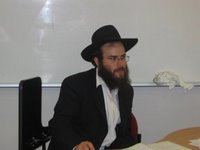
"Rabbi Yoseph Nerenberg gives a shiur
Monash Caulfield Lunchtime lectures
Merkos presents "Rabbi Yoseph Nerenberg"
No comments:
Post a Comment