5 Tammuz, 5743 [1984]
I have just received your letter of 3rd of Tammuz.
To begin with a blessing, may G-d grant that henceforth you and all your family should have only goodness and benevolence - in the kind of good that is revealed and evident.
At the same time, you must make every effort to regain the proper state of mind, despite the pain.
You should remember the teaching and instruction of the Torah, which is called Toras Chayim, the Guide in Life, and Toras Emes, the Torah of Truth, meaning that what it teaches is not just to ease the mind, but the actual truth.
Thus, the Torah, taking into account human nature/feelings, in a case of bereavement, and the need to provide an outlet for the natural feelings of sorrow and grief, prescribes a set of regulations and periods of mourning.
At the same time, the Torah sets limits in terms of the duration of the periods of mourning and appropriate expression, such as shiva [the first seven days], shloshim [30 days], etc.
If one extends the intensity of mourning which is appropriate for shiva into shloshim, it is not proper, for although shloshim is part of the overall mourning period, it is so in a lesser degree.
And since the Torah says that it is not proper to overdo it, it does no good for the neshama [soul] of the dear departed. On the contrary, it is painful for the neshama to see that it is the cause for the conduct that is not in keeping with the instructions of the Torah.
A second point to bear in mind is that a human being cannot possibly understand the ways of G-d. By way of a simple illustration:
An infant cannot possibly understand the thinking and ways of a great scholar or scientist - even though both are human beings, and the difference between them is only relative, in terms of age, education and maturity.
Moreover, it is quite possible that the infant may some day surpass the scientist, who also started life as an infant. But the difference between a created human being and his Creator is absolute.
Therefore, our Sages declare that human beings must accept everything that happens, both those that are obviously good and those that are incomprehensible, with the same positive attitude that "all that G-d does is for the good," even though it is beyond human understanding.
Nevertheless, G-d has made it possible for human beings to grasp some aspects and insights about life and afterlife. One of these revealed truths is that the neshama is a part of G-dliness and is immortal. When the time comes for it to return to Heaven, it leaves the body and continues its eternal life in the spiritual World of Truth.
It is also a matter of common sense that whatever the direct cause of the separation of the soul from the body (whether a fatal accident, or a fatal illness, etc.) it could affect only any of the vital organs of the physical body, but could in no way affect the spiritual soul.
A further point, which is also understandable, is that during the soul's lifetime on earth in partnership with the body, the soul is necessarily "handicapped" - in certain respects - by the requirements of the body (such as eating and drinking, etc.).
Even a tzaddik (righteous person) whose entire life is consecrated to Hashem [G-d] cannot escape the restraints of life in a material and physical environment.
Consequently, when the time comes for the soul to return "home," it is essentially a release for it as it makes its ascent to a higher world, no longer restrained by a physical body and physical environment.
Henceforth, the soul is free to enjoy the spiritual bliss of being near to Hashem in the fullest measure. That is surely a comforting thought.
continued in next issue


The Soul

G-d's Candle is Man's Soul
About Me

- Rabbi Rapp
- Melbourne, Victoria, Australia
- My aim to help students develop into proud and effective Jews empowering them to lead an optimistic, meaningful life and actualising their full potential. It is during these years at university that a strong and accessible organisation such as ours is so important. We are here to assist you.
Monash Clayton - Wednesdays 1.00 pm to 2.00pm
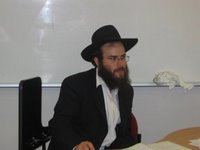
"Rabbi Yoseph Nerenberg gives a shiur
Monash Caulfield Lunchtime lectures
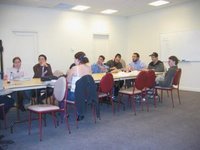
Merkos presents "Rabbi Yoseph Nerenberg"
No comments:
Post a Comment