10th of Sivan, 5712 [1952]
I trust that the Festival of Shavuoth, the Season of Our Receiving the Torah, gave you welcome opportunities to reflect upon the profoundness of the Torah and what its dissemination means to Jews in particular and to humanity at large.
I trust also that there were moments of particular inspiration in recalling the various thoughts which you and I had been privileged to hear from my father-in-law of sainted memory.
It has been my custom to convey to you a thought apropos of the festival, and I am taking the liberty of doing so again.
There is a statement in the Midrash to the effect that "If anyone tells you there is science among certain non-Jews, you may believe it; but if one tells you that there is Torah among them, do not believe it."
This terse statement contains an indication of the radical difference between general science and the Jewish religion which, to be sure, is also a profound science, though "partly" in the realm of the unfathomable.
The cardinal difference is this: Science in general has two weak points. First, it is based on certain postulates which science cannot substantiate or prove satisfactorily, and which, consequently, may be accepted, rejected, or substituted by contrary postulates.
In other words, the entire structure of science rests at bottom on unscientific principles, or, better, on premises which cannot be scientifically substantiated.
Second, science in substance is a theory declaring that if there is Cause A, there must follow Effect B, and if Effect B is to be prevented, Cause A must first be eliminated (that is assuming the postulates in question to be true).
In other words, science can never tell us, "Do this," or "Do not do that." It can only maintain that if we desire to attain B, we must first accomplish A, and if B is undesirable then A should be avoided.
That science in subject to the above mentioned two limitations is understandable, science being the product of the human intellect; for since man's abilities are limited, he cannot devise anything Absolute.
This explains weakness One. As for weakness number Two, inasmuch as all men enjoy equal rights, science cannot a priori dictate any course of human conduct. The most it can do in this respect is to predict, on the basis of the experience and knowledge at its command, that a certain chain of reactions or effects is likely to follow from a given cause. Here men of science enjoy a certain advantage over the less experienced or initiated.
The said two weaknesses of science make the cardinal superiority of the Torah plainly evident.
The very word "Torah" - meaning teaching, instruction - indicates it. For the ultimate purpose of the Torah is not to increase man's knowledge per se, but to instruct him to conduct his life to the fullest advantage of himself and the community at large. As a matter of course it provides all the knowledge necessary for the attainment of this ultimate purpose.
Inasmuch as the Torah is not the product of man but Divinely revealed at Sinai, a fact which is substantiated by undeniable multiple evidence which must be fully accepted even on scientific grounds, i.e. being given by G-d the Absolute, its foundations are likewise absolute truths, not mere supposition.
Furthermore, since G-d is the Creator of the universe and of mankind, He is not limited to the process of cause and effect, but stipulates a positive and absolute system of human conduct, of definite do's and definite don'ts.
That is why the Torah is called Toras Emes, the Law of Truth, for its teachings are absolute and its foundations are not postulates but absolute truths, hence its consequence must also be absolute truths.
It is also called Toras Chaim, the Law of Life, to show that it is not just a science whose application is arbitrary, but a system of obligatory daily living.
This is why the dissemination of the Torah is so vital. For in the final analysis the important thing is not the amount of knowledge man acquires for its own sake. To insure that man acts consistently in the best interests of himself and society, or else grope in darkness, confused by conflicting ideas and theories around him and perplexed also by conflicting emotions and instincts within him, inherent in all human beings - this is the question, and the Torah is the answer.
May we all, you and myself included among the rest of our people, be receptive to the Divine influences emanating from the Torah and mitzvoth [commandments], in the true spirit of Shavuoth, the festival of our Receiving the Torah from G-d at Sinai.


The Soul

G-d's Candle is Man's Soul
About Me

- Rabbi Rapp
- Melbourne, Victoria, Australia
- My aim to help students develop into proud and effective Jews empowering them to lead an optimistic, meaningful life and actualising their full potential. It is during these years at university that a strong and accessible organisation such as ours is so important. We are here to assist you.
Monash Clayton - Wednesdays 1.00 pm to 2.00pm
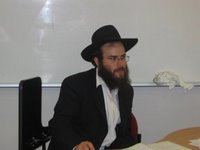
"Rabbi Yoseph Nerenberg gives a shiur
Monash Caulfield Lunchtime lectures
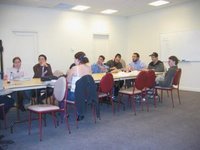
Merkos presents "Rabbi Yoseph Nerenberg"
No comments:
Post a Comment