For the past several weeks the Torah readings have dealt with the Sanctuary and its numerous vessels. The requirements were very exacting, involving many different types of building materials and complicated instructions on how to make the Sanctuary's various parts.The Torah portions of Teruma and Tetzaveh contained G-d's detailed command to erect the Sanctuary and fashion its components. Immediately afterward, the portions of Vayak'hel and Pekudei, which we read this week, speak of its actual building.
A question is asked: Why is it necessary to devote four separate Torah portions to the subject of the Sanctuary?
Every word of the holy Torah is deliberate and precise; not one word or letter is superfluous. If so, why does the Torah devote so much space to what seems to be a repetition? Surely the Torah could have enumerated all the details of the Sanctuary and then simply stated that the Jews followed them to the letter. From this we would have understood that the Sanctuary was built according to G-d's instructions.
However, in his commentary on the Torah (Gen. 24:42), Rashi explains a general principle: Whenever something is particularly beloved to G-d, the Torah goes to great length in its description, and indeed may repeat itself several times, even if nothing new is added by the repetition.
The Sanctuary and its vessels were extremely beloved by G-d. The Sanctuary was also especially important to the Jews, for it was the means by which G-d's Presence rested among them, as it states, "And they will make Me a Mikdash (Sanctuary) and I will dwell among them."
Moreover, to the Jews the Sanctuary was particularly beloved, for it testified that G-d had forgiven them for having made the Golden Calf. That is why it was called "the Mishkan of Testimony."
Precisely because of the Sanctuary's great significance, both to G-d and to the Jewish people, a full four Torah portions are devoted to the Sanctuary: Teruma, Tetzaveh, Vayak'hel and Pekudei.
The Jewish people's dedication to the Sanctuary expressed itself in their overwhelmingly enthusiastic response to the call for donations. In fact, they contributed so much of their personal wealth and possessions that an order had to be given for them to cease!
In a like manner, it is not enough to be content with the simple performance of mitzvot. Each one of G-d's commandments must be precious and dear to us, observed with willingness and devotion, and performed with alacrity and love.
Adapted from Likutei Sichot, Volume 16


The Soul

G-d's Candle is Man's Soul
About Me

- Rabbi Rapp
- Melbourne, Victoria, Australia
- My aim to help students develop into proud and effective Jews empowering them to lead an optimistic, meaningful life and actualising their full potential. It is during these years at university that a strong and accessible organisation such as ours is so important. We are here to assist you.
Monash Clayton - Wednesdays 1.00 pm to 2.00pm
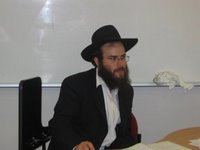
"Rabbi Yoseph Nerenberg gives a shiur
Monash Caulfield Lunchtime lectures

Merkos presents "Rabbi Yoseph Nerenberg"
No comments:
Post a Comment