Last week we read about the Giving of the Torah at Mount Sinai. This week, in the portion of Mishpatim, we begin learning the specific commandments the Torah contains.There are three categories of mitzvot (commandments) in the Torah: Chukim (statutes) are commandments that are above our understanding. Eidot (testimonies) are mitzvot that we would not have arrived at without the Torah. However, once G-d commanded us to obey them, we are able to understand their rationale. Mishpatim (judgments) are simple commandments that are compelled by human logic, laws that society would keep even if the Torah had not commanded their observance.
Most of the Torah portion of Mishpatim deals with these seemingly self-evident laws. Which leads to the following question:
After the extraordinary spectacle at Mount Sinai, why does the Torah stress the rational category of mitzvot, as opposed to the others? Furthermore, why was a supernatural revelation necessary for rules and regulations we would have figured out on our own?
The answer is that the Torah is teaching us how to relate to the whole concept of rational mitzvot. The natural inclination is to base these mitzvot on our intellectual understanding. It hardly seems even necessary to believe in G-d to arrive at the conclusion that it is wrong to harm others, or that we must compensate someone we have injured. These principles are patently obvious.
However, by enumerating the "logical" judgments first, the Torah emphasizes that even these mitzvot must be observed out of faith in G-d. We obey the Torah's rational laws not because they are logical, but because G-d has commanded us to obey them. Indeed, the only basis and source of all mitzvot, regardless of whether or not we understand them, is our Divinely-given Torah.
This is important for several reasons:
A truly ethical life cannot be based on the human intellect, as it is simply too flexible and open to manipulation by the will. If a person really wants to do something, not only will he develop a philosophy by which such action is justified, but he will even turn it into a "mitzva"! The human mind can also devise logical "proofs" for contradictory theorems. It is thus too unreliable a foundation for a moral existence.
Moreover, just as G-d is Infinite and without end, so too is His holy Torah. Even the simplest and most logical mitzvot are endlessly deep. If a Jew observes a mitzva only because he understands it, he misses out on all its inner significance.
By basing our observance on faith, we ensure that our moral system will be stable and unwavering. We also connect ourselves to G-d through even the most "logical" of mitzvot.
Adapted from Volumes 16 and 3 of Likutei Sichot


The Soul

G-d's Candle is Man's Soul
About Me

- Rabbi Rapp
- Melbourne, Victoria, Australia
- My aim to help students develop into proud and effective Jews empowering them to lead an optimistic, meaningful life and actualising their full potential. It is during these years at university that a strong and accessible organisation such as ours is so important. We are here to assist you.
Monash Clayton - Wednesdays 1.00 pm to 2.00pm
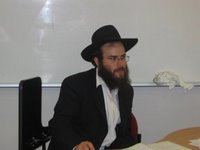
"Rabbi Yoseph Nerenberg gives a shiur
Monash Caulfield Lunchtime lectures

Merkos presents "Rabbi Yoseph Nerenberg"
No comments:
Post a Comment