Erev [Eve of] Rosh Chodesh Shvat, 5743
At the outset, on behalf of Mrs. Schneerson as well as on my own behalf, I wish to convey our sincere appreciation for your kind and considerate care in connection to the recent incident that occurred with Mrs. Schneerson. [Thank you] for your immediate response and home visitation at an inconvenient hour, etc., [and] all this in addition to your having provided her with your expert and skilled treatment and care.
I surely need not stress to you how important it is to the patient that the doctor expresses personal interest and attention, particularly as this constitutes a significant aspect in the patient's healing. As you yourself correctly noted in the course of our conversation, the mind has a critical degree of influence over the entire body and one's state of mind directly affects the healing process.
We extend our thanks in anticipation as well of your continued interest and assistance.
I hope and pray that G-d, "Healer of all flesh and Performer of wonders," will bless you with success regarding all your patients, including this present one.
I had occasion to hear a thought from my father-in-law, may the memory of a tzaddik [righteous person] be for a blessing - a thought that has its place in our Torah, which is called the Torah of Life (as it serves as our guide and source of life) - that in order to assure the success of the medical treatment, the remuneration for the doctor's services are to be in keeping with the medical stature of the treating physician.
In point of fact, this principle applies to all professions and services, including communal services. It need not be said that my father-in-law put this into practice and I wish to do the same.
I therefore am taking the liberty to enclose my check, although I am not sure whether this is the appropriate payment. I am sure, however, that if this sum does not suffice, you will see to it that your secretary contacts my secretary so that I will be able to rectify the matter. Together with the payment comes the traditional Jewish blessing, "Use it in good health."
One of the primary reasons for the above principle is the fact that the Torah is aware that a doctor or someone with another occupation has fiscal responsibilities to his family and community, etc., responsibilities that he can adequately take care of only if his services are adequately paid for.
Therefore, if the receiver of the services does not satisfactorily reimburse the provider of the service, a thought might arise in the doctor's mind (fleeting as it might be) that it would be acceptable for him next time to delay treating this individual in favour of an individual who pays what is expected of him.
Consequently, the Torah strives to remove even the possibility of such a thought. Thus, whatever occupation Providence had in mind for an individual to carry out for the benefit of others, this will always be done with total dedication and devotion.
Once again, my great thanks. With respect and personal regards,
P.S. After this letter was written, your official bill was received. Enclosed please find a check. However, as I emphasized, this is a formal payment while my letter and the [other] attached payment are on a personal basis, as a much deeper and more personal gesture than that of the formal relationship between doctor and patient.
From Healthy in Body, Mind and Soul compiled by Rabbi Sholom B. Wineberg, published by Sichos in English
* * *
14 Kislev, 5720 - 1959
In reply to your letter of the 8th of Kislev in which you describe the times that you go to sleep and arise, and you ask my opinion if this conduct is correct or whether it should be changed:
The ultimate criteria for the above should be in keeping with the exposition offered by the Alter Rebbe in Hilchos Talmud Torah, regarding a teacher of children. [There the Alter Rebbe states that a teacher] should not stay up so late in the night that [his lack of sleep] will affect the efficacy of his teaching the next day. (See Hilchos Talmud Torah 1:12.)
Understandably, the same applies to one's own study of the Torah [- one should not stay up too late if it will keep him from being alert when he awakens the next day].
Since the amount of sleep a person needs is different from one individual to the other, depending on the nature of his body and the amount of sleep he is used to getting, etc., [it is therefore impossible for me to advise you as to the exact amount of sleep you need].
The statements in the various codes of law regarding the amount [of time] a person should sleep is but a median amount and applies to the majority, for Torah speaks to the needs of the majority, [however, individuals may well vary as to the exact number of hours of sleep they require].
You should test yourself [to see] how many hours of sleep you require, so that when you awaken you will be able to study with the necessary amount of [alertness and] comprehension. Based on this test, you should establish the hours of going to sleep and waking.
It is self-understood that in any case you are to carefully observe the time of the morning Shema, [i.e., that you arise in time to recite the morning Shema], a matter that is of particular import during the summer [when there is a greater possibility of missing the proper time for the recitation of the morning Shema].
* * *
14 Sivan, 5718 - 1958
You write to me about feeling weak and also about suffering from
insomnia:
It may very well be that both matters are a result of your failure to lead an orderly life, without having set and established times for food, drink and sleep, etc.
Moreover, it is well known how our Rebbeim demanded [from others] and were also exacting and strict with themselves in regard to keeping an orderly life style. They explained and expounded on how lack of routine and order prevents success in the performance of Torah and Mitzvos.
This applies in particular to you and your work, as you are engaged in sacred labour, the [sacred] work of [the tribe of] Zevulun that [spiritually] precedes [the labour of the tribe of] Yissachar. The [orderly] manner [demanded] of [one who engages in] your [type of] work is clearly stated in the verse, when it states: "Rejoice Zevulun as you go out [and conduct your work in an orderly fashion]."
It would be advisable that you consult with a doctor so that he may calm you of your fears [regarding your weakness and insomnia]. Also ask him to establish for you an orderly routine for eating, drinking, etc. You should - as much as possible - make sure to stick to this routine.
May G-d send His healing words and heal and strengthen you.
Translated and compiled by Rabbi Sholom B. Wineberg, reprinted from Healthy in Mind, Body and Spirit, published by Sichos in English


The Soul

G-d's Candle is Man's Soul
About Me

- Rabbi Rapp
- Melbourne, Victoria, Australia
- My aim to help students develop into proud and effective Jews empowering them to lead an optimistic, meaningful life and actualising their full potential. It is during these years at university that a strong and accessible organisation such as ours is so important. We are here to assist you.
Monash Clayton - Wednesdays 1.00 pm to 2.00pm
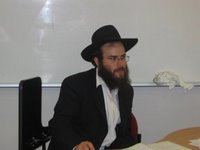
"Rabbi Yoseph Nerenberg gives a shiur
Monash Caulfield Lunchtime lectures
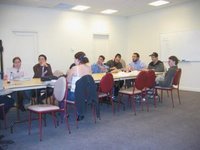
Merkos presents "Rabbi Yoseph Nerenberg"
No comments:
Post a Comment